From Mill Town to Silicon Valley: Success through Perseverance and Grit
Tell us about yourself.
I grew up in Millers Falls, MA, a village in central Massachusetts with a storied history as a mill town. As a child I remember the mill workers walking to their jobs, a whistle blowing at lunchtime and then an hour later for them to return. I saw hard work, loyalty, and dedication, but it also looked monotonous.
My father was fortunate enough to work for Northeast Utilities, then Western Mass Electric, and due to that connection, I had a front row seat to learn about power companies. At the time, nuclear power was in its original heyday with many plants being constructed nationwide. The early economics were terrific and nuclear technology was fascinating. I was hooked and my aim was to become a nuclear engineer.
What was your RPI experience like?
Growing up in a rural area, my secondary education was not advanced. I had great teachers, but the curriculum didn’t offer even one AP class. My first semester at RPI was an eye opener and I quickly adapted by buckling down to get the grades I was used to receiving in high school. That semester set the tone for my whole time at RPI.
Other than the memory of marching through a cold morning to my first F-Test, my memories today center around two influential professors. I had a couple of courses with Dr. Rodney Gay, and I also did a senior project for him, which helped him on one of his industry contracts. Dr. Gay later hired me to work with him in California, where my wife and I became best friends with him and his wife. The four of us sailed together in the Caribbean for three weeks on a bareboat, in the Grenadines. Rodney is a successful entrepreneur and he founded several companies, a couple that I was a part of. Those experiences started me on my on entrepreneurial trajectory that continues to this day.
Dr. Richard Lahey was the other influential professor based solely on his graduate level Two-Phase Flow course I took as a senior. People that know their subject matter extremely well can take complicated concepts and explain them so simply. I will never forget his lecture on the growth of bubbles and the velocities and mass transfer at the bubble surface as it expands.
What do you think distinguishes RPI education and student experience? Did RPI prepare you for success?
None of my career successes would have been possible without the lessons that RPI taught me regarding effort and perseverance. The nice thing about RPI is that different students, with different backgrounds and capabilities, can find the missing pieces that they need to be successful. It could be something related to work ethics, or the physics of expanding bubbles, or it can be the important relationships that are built. The education is crafted by what the student chooses to dive into and take away for themselves.
RPI’s distinguishing features are two-fold to me. First, as a technology focused school, you get to meet and work with others that you have something in common. Even though the students are all different in their interests and capabilities, you know underneath that there is a common thread of science and technology that you have with them.
The second feature is the undergraduate focus. While graduate level courses and degrees are there for those that want to stretch, undergraduate education is primary.
I’d also like to mention the Co-op program that I participated in. At the time, it seemed much higher profile than it is today, with a feature being that a participant still graduated in 4 years. I had one co-op assignment with the Nuclear Regulatory Commission and another with Combustion Engineering. These experiences were critical in shaping areas for me to focus on while giving me my first taste of being an engineering professional. I highly recommend this program to any engineering student today.
Tell us about your journey. What attributes are important to success as an entrepreneur?
Out of school I worked for two nuclear consulting companies, the second of which was where I rejoined Dr. Gay in California. I remember taking thermal measurements in the Maine Yankee spent fuel storage pool with Dr. Gay during their 10-year full core offload. That was a crazy experience, and I still enjoy telling stories of that work, dangling over the railing of a nuclear spent fuel storage pool.
Dr. Gay left to join a startup, and I decided I should try to take advantage of living in Silicon Valley, so I worked a few years at Memorex/Burroughs doing finite element analysis of thin film heads for large disk drives. After learning that advancement at this company was going to be difficult for an ME/Nuclear Engineer, I rejoined Dr. Gay at that startup company where we were using PCs for the first time as pre and post processors for large nuclear industry computer codes. here I learned that I was valuable at presenting and demonstrating our technology to prospective companies.
With Dr. Gay as an investor, I then founded a startup related to computer security. After a few years of muted success, I extracted myself from this endeavor for a return to software and the power sector.
I co-founded a company to help the Electric Power Research Institute (EPRI) deliver better software to their members. At that company I led the initiative where 20 utility companies funded our private company to develop an SO2 Allowance Tracking Workstation. That product grew to be used by over 50 large power companies representing about 90% of all the allowances in the market. Leveraging that success, I used that same industry collaborative funding model to develop an information management solution for Title V of the Clean Air Act. That solution evolved to become a leading solution for enterprise environmental data management, including greenhouse gases. ended up traveling globally showing how our technology could help companies like Shell, Exxon, Eni and many others to meet their greenhouse gas reporting needs. After 15 years, this company was acquired by another public company.
I share this career story because my path was not traditional, elegant or straightforward. There were lots of twists and curves. And yes, there were failures. I started as engineer writing code and ended as a business development person using my technical skills to explain technology to engineers all over the world. I have continued to consult and create companies even as I have moved toward retirement.
Perseverance and grit are probably the two most important attributes that I think of for success. PI can supply the core knowledge for you, and sometimes opportunities happen easily for people to take advantage of. Other times, you have to persevere, hunt them down, and make them happen.
When talking to Dr. Garde, he did ask the tricky question, “But you have to be willing to take the risk to give up everything to do that.” Yes, you do. It is scary, and hopefully you can rely on a friend or partner and your own confidence that if the next step doesn’t work, you will land on your feet with something else. In Silicon Valley, participating in a startup that fails makes you even more valuable. Executives and investors like to hear that you have learned lessons on someone else’s money. When people ask how to feel confident to make the leap, I borrow from Nike and tell them you have to “Just Do It.”
What is your advice to RPI students, especially those in Nuclear Engineering, who are thinking about entrepreneurship?
While courses in entrepreneurship are helpful, I think the idea of starting company directly out of school might not be the best approach. It’s important to have mentors and work experience to improve the chance that your first entrepreneurial experience will be successful.
Through working in an industry, you can identify a gap somewhere that a new company can fill, perhaps a service offering or widget that a company needs to improve their performance. Being able to start a company with a built-in customer is a great way to reduce risk. Sometimes companies will help you fund your startup if your offering is something they really need.
I am a big fan of bootstrapping companies. Find a way to offer a service or simple product offering that can deliver revenue fast to support your new company. Use the revenue to fund your growth and keep the ownership of your company to the founders. If you can do this, you truly have your own company and not one that you are just operating for a group of investors.
You support RPI philanthropically. What motivates you to give back?
Firstly, I was an RPI Medal winner which resulted in the school generously supporting me and my family to make an RPI education happen for me. It’s only natural that I feel a sense of giving back based upon the generous support they had for me.
In addition, with the growing cost of education, my wife and I would like to help others to achieve their dreams. The best way to do that is through the various funding programs that the school has to continue to offer support to worthy new students.
I recently met a young man, a native of St. John, who enthusiastically explained to me why he was applying to various schools to become a Nuclear Engineer. I was able to introduce him to RPI and the school was able to accept him with great support for him and his family. It was nice to see the school be able to respond so well to a prospective student.
What do you do for fun?
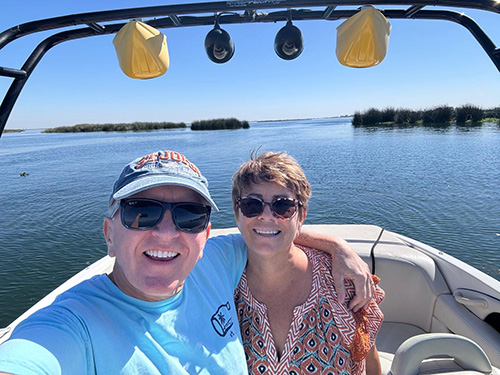 My wife and I are water people, and we spend half the year in St. John of the US Virgin Islands where we enjoy swimming, snorkeling, boating and sitting on the beach. This year we were able to introduce our granddaughter to the warm water and that was exciting.
I’ve always done a lot of writing in my career, from product brochures to case studies and proposals. For over 20 years I had the idea for a speculative fiction novel based upon what I believe is a more realistic possibility for the end of the world. A couple of years ago I had the opportunity to write this story, and it was fascinating to see it unfold while I was writing. I am now learning about the revision process and hope to soon be querying for an agent.
It’s interesting to see that again perseverance and grit are coming into play as I grind through the process of writing and publishing a book!